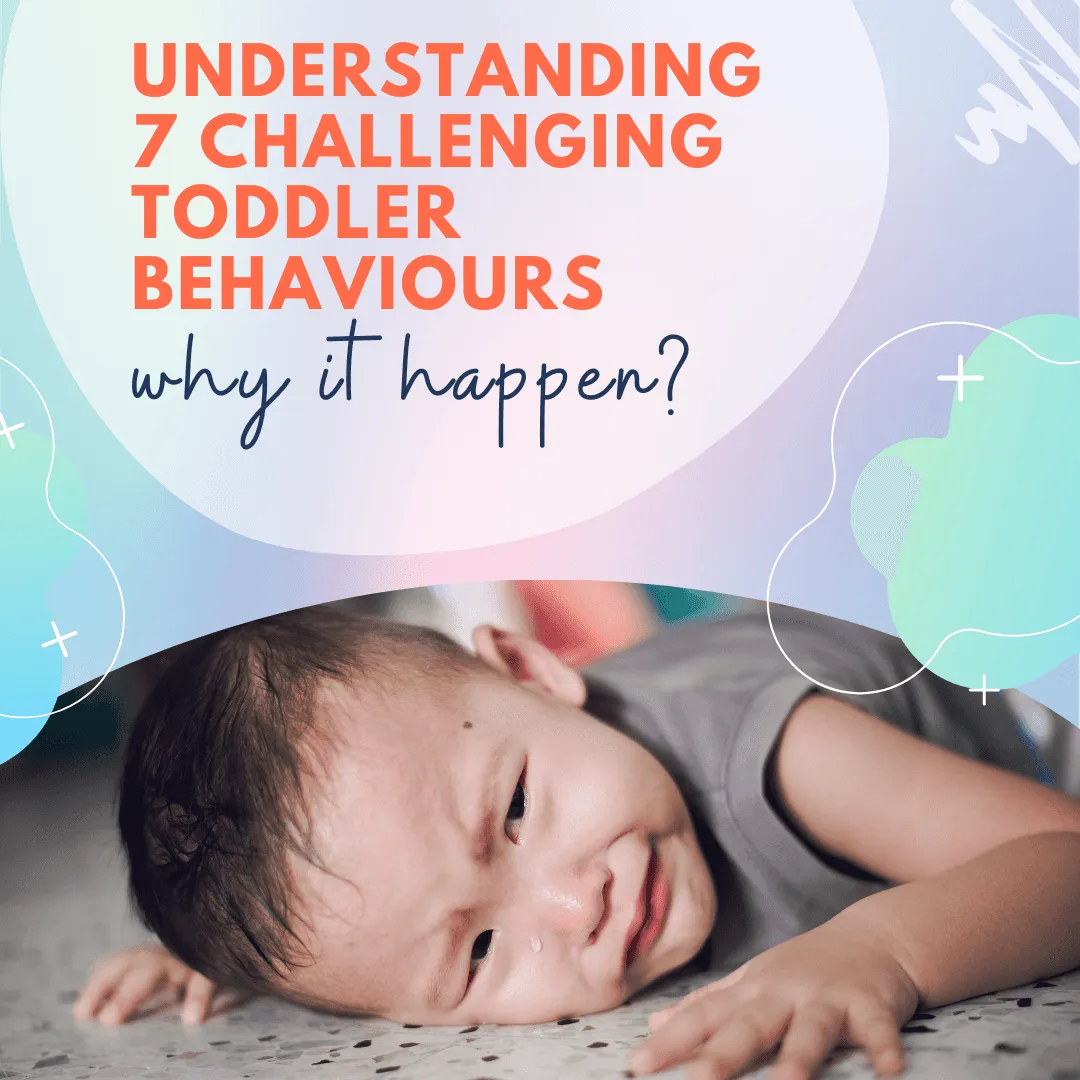

Understanding 7 Challenging Toddler Behaviours
Have you had a moment where your child is hitting their stride with the terrible twos and probably a few other toddler behaviours that...


You've scrolled through countless Google reviews, asked in multiple parent groups, and toured endless schools that both seemed "nice." You still can't decide between the bright Montessori with the long waitlist and the cosy play-based centre down the street.
Here's what's actually happening: you're trying to find the "best" preschool when what you really need is the right fit.
There is rarely one preschool that is objectively better than the rest for every child. There is often a preschool that fits your child and your family better right now. That might sound like a small distinction, but it changes everything about how you search, visit, and decide.
This guide will walk you through a practical process for choosing a preschool that works—not perfectly, but clearly and with less regret.
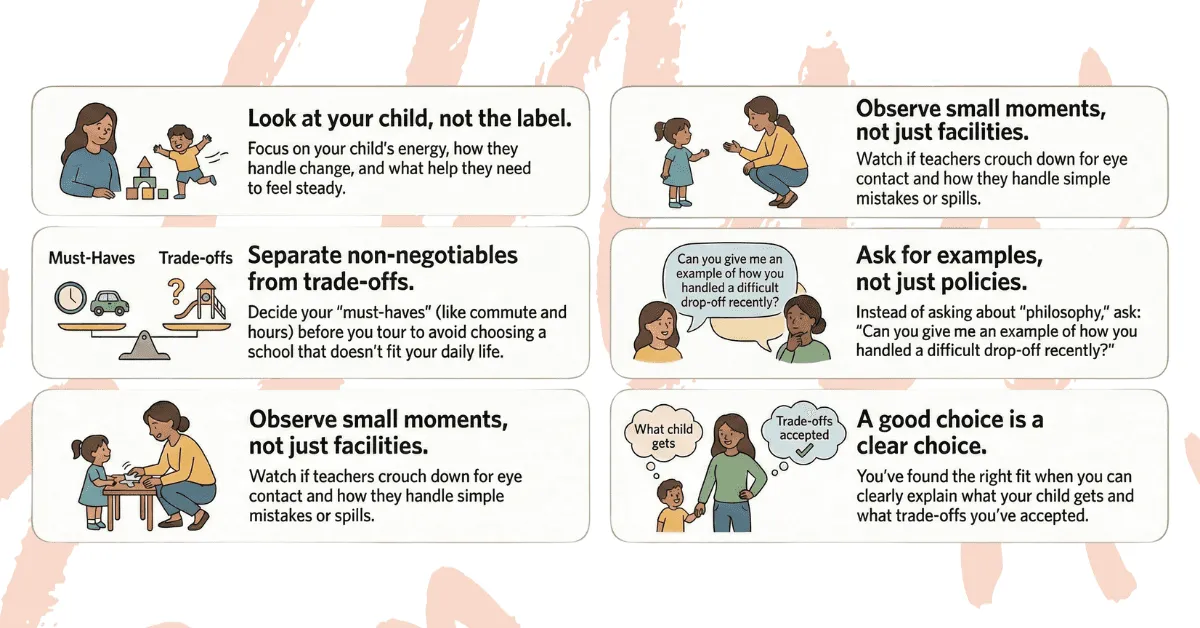
If you want a simple overview before going deep, here's what many parents find helpful:
Start with your child's needs
Set your non-negotiables
Shortlist a small number of schools
Visit and observe, then ask specific questions
Compare with a simple method
Decide, then support the settling-in period
Let's walk through each step.
When parents search for advice on choosing a preschool, they often begin with programme labels. Montessori, play-based, inquiry, "more academic." Those can matter, but they don't always predict day-to-day experience.
A clearer starting point is your child. What helps them feel safe, steady, and willing to try?
Do they need lots of movement to stay calm and focused?
Do they get overwhelmed by busy, noisy environments?
Do they melt down after overstimulating days?
Do they join groups quickly, or do they observe first?
Do they connect better one-to-one than in a crowd?
Are they drained by constant interaction or energised by it?
Do they struggle with new places and new routines?
Do they adapt fast, then show stress later at home?
Do they need predictability to feel secure?
Here's why this matters. Maya screamed "Don't leave me!" for three weeks straight at drop-off, then played happily until pickup. Liam smiled and waved goodbye every morning, then spent an hour watching other children from the book corner, touching nothing. Both children "looked fine" to casual observers, but they needed very different kinds of support.
Without a fit lens, it's easy to misread what you're seeing on a tour or during a trial period.
Not necessarily. Some reserved children thrive with clear routines and gentle structure. Others shut down further when there's too much adult direction. What matters more is whether teachers notice the quieter children and create space for them to engage in their own way.
This step prevents a common problem: falling in love with a school on tour, then realising three months later that the daily routine doesn't actually work for your family.
These are factors that create ongoing stress if they don't fit:
Commute and location (how much travel can you sustain twice daily?)
Operating hours (do they cover your work schedule with margin?)
Fees and what's included (meals, nappies, excursions, consumables?)
Language needs (if applicable to your family)
Dietary, sleep, medical, or developmental needs
These are the "not perfect, but acceptable" areas where you're willing to compromise:
Smaller outdoor space, but stronger routines
Less emphasis on early academics, but stronger confidence and communication
Larger centre, but less of a small-group feel
Older building, but more experienced staff
Getting clear on the difference between these two lists will save you hours of agonising later.
Many parents compare play-based versus Montessori approaches because they're really asking a practical question: what will my child actually do all day, and how will teachers guide them?
Instead of choosing based on labels, look for what the label looks like in real classroom practice. Here's what to watch for and what questions reveal the truth behind the marketing language.
What you might see: A three-year-old abandons the water table after three minutes to join a pretend bakery. The teacher follows their lead, asking questions: "What are you baking? How will you know when it's ready?"
Purposeful play activities with clear learning goals, language-rich interactions, stories, role play, building, and sensory play. Teachers guide children through questions rather than direct instruction.
What to clarify:
How do you support early language and early literacy during play?
How do you build routines and boundaries when children resist transitions?
How do you develop attention and persistence, not just free choice?
What you might see: A three-year-old spends twenty minutes pouring water between jugs. The teacher doesn't interrupt. When the child finishes, they clean up independently and choose their next activity from the shelf.
Structured materials and longer work periods. Children practising independence and concentration. Teachers observing and guiding rather than leading group instruction.
What to clarify:
How do you support social play and collaboration between children?
How does the approach adapt for children who need more sensory input or movement?
What happens when a child resists structure or ignores the materials?
What you might see: Children notice ice melting in the playground. Over the next two weeks, this becomes a project about freezing, melting, temperature. Teachers document children's questions and theories. Children test ideas with ice cubes, frozen fruit, warm water.
Projects evolve over time, not as one-off tasks. Children's questions shape activities. Teachers document thinking and progress visibly.
What to clarify:
How do you build foundational skills consistently when projects change?
How do you support children who need structure to feel secure?
What happens if a child isn't interested in the current project?
The key insight here: a philosophy is only as good as how it's adapted to the real children in the room. A rigid Montessori teacher and a chaotic play-based classroom can both miss the mark. Look for teachers who understand the approach and adjust it for different temperaments.
This is the part that reveals daily experience. Not because anything dramatic happens, but because you can see how the school operates when things are ordinary.
Observe small moments, not just the welcome speech.
Do teachers crouch down to make eye contact, or talk over children's heads?
Is guidance calm and specific ("Use two hands on the ladder"), or mostly warnings ("Be careful!")?
Do teachers notice the quieter children, or focus only on the loudest voices?
When a child makes a mistake or spills something, what's the teacher's first response?
A "good day" at preschool is often about transitions being handled well.
How do they support drop-off and separation?
What happens during clean-up, meals, nap time, and outdoor time?
How do they respond if a child refuses group time?
Is the day predictable, or does it feel reactive and rushed?
Watch for whether transitions are explained in advance ("In five minutes, we'll pack away and have morning tea") or announced suddenly.
Try to look beyond the display boards.
Do you see children's ideas captured in their own words?
Do you see progress over time, or just this week's craft?
Do you see different levels of challenge for different children?
Are the displays at adult eye level, or created for children to revisit?
Principles are easy. Examples are honest. Ask for examples.
What happens when children hit, push, or grab toys?
How do teachers support emotional regulation in the moment?
How do they help children repair after conflict?
How do they involve parents when something repeats?
Listen for concrete language ("We help them use their words and offer solutions together") rather than jargon ("We use positive behaviour support frameworks").
Ask about the routine, not just the policy.
What's the pick-up and handover process?
How is visitor access controlled?
What's the sick policy, and how do you communicate with parents?
How do you handle incidents, and what does reporting look like?
These questions sound boring, but they predict daily peace of mind.
A long list of preschool tour questions can overwhelm. The goal isn't to ask everything. It's to ask questions that reveal how a school operates when things are hard, not just when things are going smoothly.
"How do you support children who struggle with drop-off?" Listen for: specific strategies, timelines, parent involvement, how they adapt the approach for different children.
"What does a typical settling-in plan look like in the first month?" Listen for: whether they have a plan at all, or whether they expect children to "just adjust."
"What do you do when children hit or push?" Listen for: immediate response (safety first), teaching moment (helping children understand impact), follow-up (checking in later, involving parents if it repeats).
"Can you give me an example of a recent conflict between children and how you handled it?" This reveals their real approach, not their aspirational one.
"How often do you update parents, and what does that look like?" Listen for: daily informal chats, weekly summaries, parent-teacher meetings, whether they reach out proactively or wait for parents to ask.
"How do you raise concerns, and what happens after that conversation?" Listen for: a process, not a defensive reaction.
"How do you support early language and confidence in speaking?" Listen for: specific practices, not general statements about "language-rich environments."
"How do you support children who learn at different speeds?" Listen for: differentiation, observation, flexibility, not "we treat everyone the same."
After any answer, you can ask: "Can you give me an example of when that happened recently?"
This separates practiced responses from lived experience.
After visiting two to four preschools, everything can start to blur together. This is normal. A simple method helps you compare fairly without turning it into a spreadsheet obsession.
Pick six categories and score each school from 1 to 5. Keep notes short.
The six categories:
Child comfort and engagement (what you observed during the visit)
Teacher-child interaction (quality of attention, warmth, guidance)
Daily rhythm and routines (how smoothly the day flows)
Communication with parents (clarity, frequency, openness)
Practical fit (hours, commute, fees, logistics)
Confidence in safety and health (your gut feeling about wellbeing)
What the scores mean:
5 = This is exactly what we need
4 = This works well for us
3 = This is acceptable, with trade-offs we understand
2 = This concerns us but isn't a dealbreaker
1 = This doesn't work for our family
Then add one line for each school: "If we choose this school, what are we accepting?"
For example: "If we choose Sunshine Montessori, we're accepting a longer commute and less outdoor space, but gaining strong independence-building and calm, focused environments."
This turns "vibes" into a clear trade-off, which reduces regret later.
If two schools feel equally good, ask yourself:
Which school's approach to behaviour guidance felt more aligned with our family values?
Which teachers did we feel we could talk to openly?
Which environment did we imagine our child in more easily?
Sometimes your visceral response to a space or a teacher matters, even if you can't articulate exactly why. You're allowed to make an intuitive call after doing the analytical work.
Parents often search "my child isn't settling in at preschool" or "how long does preschool adjustment take" during those first difficult weeks. The answer is rarely a fixed timeline.
A more useful way to think about the adjustment period is direction, not duration.
Week 1-2: Lots of tears, clinginess, or complete shutdown. Some children regress with toilet training or sleep. Some hold it together at preschool, then melt down at home.
Week 3-4: Tears might continue, but you'll see moments of engagement. They might talk about a friend, mention an activity, or ask when they're going back.
Week 5-8: Drop-off might still be hard, but the distress is shorter. They recover faster. Play becomes more involved. They start to build routines.
Direction matters more than speed. Watch for:
Is comfort improving over time, even slowly?
Is the school communicating clearly about what they observe?
Are there consistent steps being taken to support your child?
Is your child showing signs of stress beyond the preschool setting (sleep disruption, aggression, withdrawal, regression)?
If things aren't improving after six to eight weeks, or if your child seems increasingly distressed rather than gradually settling, it's time for a serious conversation with the preschool. Sometimes the fit genuinely isn't right, and that's not a failure—it's important information.
Consistency: same drop-off routine, same time, same person when possible
Connection: a comfort item from home, a goodbye ritual, a photo in their bag
Communication: daily check-ins with teachers, not just about problems but about what went well
Patience with regression: your child might need extra reassurance at home while they're being brave at preschool
The adjustment period tests your choice. If the school supports you through it with clear communication and genuine care, that's one of the strongest signs you've chosen well.
If you can explain your choice simply, you're usually on solid ground.
You know:
What your child needs right now
What your family can sustain
What you observed during visits
What trade-offs you accepted intentionally
That's not perfect, but it's clear. And clarity makes the hard moments easier to navigate.
What is the best age to start preschool?
There is no single best age. Some children thrive socially at two and a half because they enjoy routines and other children. Others benefit from waiting until separation feels easier, often closer to three or four. Consider your childcare needs, your child's temperament, and what environment will support them best at the age you're considering. Starting earlier doesn't guarantee better outcomes. Starting later doesn't mean they'll be behind.
How many preschools should I visit before deciding?
For most parents, visiting two to four preschools is enough. More than that can lead to comparison fatigue where every school blurs together. If everything feels similar after four visits, revisit your non-negotiables and compare using fewer categories. Quality of observation matters more than quantity of visits.
What should I observe in a preschool classroom?
Watch teacher-child interaction, daily routines, behaviour guidance, and how children spend most of their time. Facilities matter, but the day-to-day experience matters more. Notice the small moments: how teachers respond to mistakes, how they guide transitions, whether quieter children are included, whether the energy feels calm or chaotic.
How do I know if a preschool is a good fit for my child?
Fit shows up in engagement and support. Does your child seem increasingly comfortable over time? Does the school understand your child's specific needs? Do they communicate clearly about what they're seeing and what they're doing to help? Do you feel heard when you raise concerns? Fit isn't about perfection—it's about partnership.
What are the most important preschool tour questions to ask?
Focus on settling-in support, daily routines, behaviour guidance, and parent communication. These areas reveal more than broad statements about curriculum or philosophy. Ask for examples, not principles. "Can you give me an example of a recent time when a child struggled with drop-off and how you handled it?" tells you far more than "We have a strong settling-in policy."
Should I choose a preschool based on the programme (Montessori, play-based, etc.) or the teachers?
Teachers matter more than the label. A warm, observant teacher in any programme will understand your child better than a rigid teacher following a prestigious philosophy. Look for educators who adapt their approach to the real children in front of them, not just to the theory.
What if my child doesn't settle after a month?
One month is still early. Many children take six to eight weeks to truly settle, and some take longer. What matters is direction: is comfort gradually improving? Is the school communicating regularly and trying different strategies? Are you seeing moments of engagement, even brief ones? If there's no improvement or things are getting worse after eight weeks, it's time to reassess whether the fit is right.